
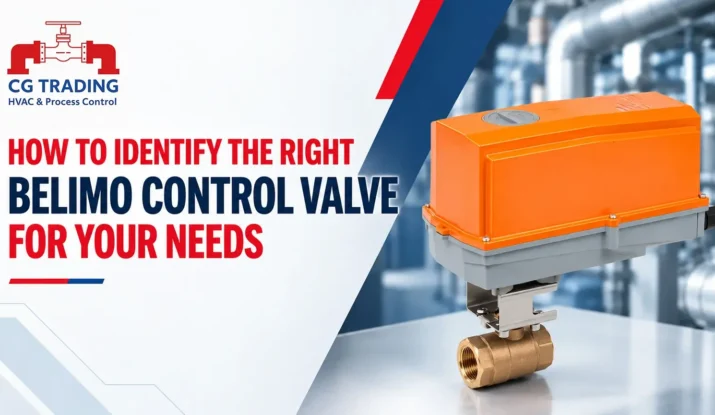
Quick Summary: Choosing a Belimo control valve is all dependent on the flow pattern, the pressure, and actuator needs. This article takes you through each decision, shows where buyers go wrong on sizing, and answers the most common questions.
Table of Contents
Introduction
A chilled water coil that overcools one floor and starves another is rarely a coil problem. More often, the valve controlling it was chosen without enough thought. A Belimo control valve is one of the most common choices for heating and cooling water circuits, yet the range of Belimo HVAC valves is broad, and the wrong selection of the valve results in wastage of pumping energy, upsets comfort, and forces rebalancing later. This article explains how to identify the right model for your system. You will see how two-way and three-way designs differ, when a Belimo pressure-independent control valve is a better option than any other valve, what the Belimo ball valve design changes, and how to match a Belimo valve actuator to the working conditions. We also cover sizing mistakes that cost projects time, followed by answers to the questions engineers and procurement teams ask most.
What the Belimo Control Valve Must Do
Two decisions narrow the field quickly: the flow pattern and the valve design. The functions of these valves are:
1. Two-Way or Three-Way
A two-way valve regulates the flow through a coil, which suits variable flow pumping. A three-way valve diverts water around the coil instead, so the circuit keeps flowing even when the coil needs little. Belimo’s B2 series covers two-way valves and the B3 series covers three-way ones, so the model code tells you the function easily. Confirm your pump strategy before you order, because bypass flow keeps pumps working when the load drops.
2. Why a Belimo Ball Valve Has a Disc Inside
A standard ball valve has a very high flow coefficient for its size. Tested alone, it shows an S-shaped curve, and once installed in a system, that curve distorts, which makes smooth control difficult. The Belimo control valve fixes this with a characterizing disc. The disc and the hole in the ball together give an equal percentage characteristic, similar to a globe valve of the same size, so flow rises slowly and predictably as the valve opens. Belimo calls this design the Characterized Control Valve, or CCV.
Pressure Dependent or Pressure Independent?
A CCV delivers flow based on valve position and on the pressure across it. When other valves in the system open and close, that pressure shifts, and your flow shifts with it. A Belimo pressure-independent control valve removes the problem by placing a differential pressure regulator in series with the control valve. The regulator absorbs pressure swings, so flow depends only on how far the actuator opens the valve. Each unit leaves the factory with a flow setting that you can change on site, and no valve authority or Cv calculations are needed. Here is how three common options compare:
- CCV: This Belimo Control Valve type fits circuits where differential pressure stays fairly steady.
- PIQCV and ePIV: Pressure-independent valves for variable flow systems. The PIQCV is compact, and the ePIV adds electronic flow measurement.
- Energy Valve: Adds flow measurement, temperature sensing, energy metering, and Delta T Manager logic. That logic limits overflow through coils that already deliver their full output, which helps with low delta T. Sizes run from ½ inch to 6 inch.
Check the working differential pressure range of any pressure-independent model first. Outside that range, it cannot hold flow steady.
Match the Belimo Valve Actuator to the Work
A Belimo Control Valve body is only half the decision. A Belimo valve actuator decides how the valve moves and what happens when power fails. Belimo offers non-fail-safe families such as LR, NR, and AR, spring return models such as TFR, AFR, and LF, and the electronic fail-safe GKR. Spring return and electronic fail-safe types move the valve to a set position on power loss, which matters for coil freeze protection. Then confirm the control signal, either on/off or modulating, so the actuator talks properly to your controller. For outdoor or damp locations, ask about NEMA 4X-rated N4 versions.
Which Belimo Valve Fits Which Application
Knowing where each valve usually works best makes the choice much easier, so here are four common setups:
- Fan coil units and small air handlers: A compact pressure-independent valve keeps flow steady as other units switch on and off, which stops zones from upsetting each other.
- Large air handler coils: An Energy Valve suits them, since its Delta T Manager helps cut pumping and plant operating costs.
- Stable, balanced loops with simple control needs: A CCV with a suitable actuator is usually enough.
- Bypass or mixing circuits: A B3 series three-way valve fits.
Treat these only as starting points, then verify your Belimo Control Valve choice against your design data.
Selection Mistakes Worth Avoiding
Most selection errors happen after the valve type is settled. These are some of the most common mistakes to look out for:
- Sizing by pipe diameter: Select by required flow instead, because the coil, not the pipe, sets the demand. A valve matched to the pipe is often larger than the coil needs, and the smallest pressure-independent model that covers the flow is the usual choice.
- Ignoring materials: Belimo CCVs come with chrome-plated brass or stainless steel balls and stems. Check them against your fluid and water quality.
- Skipping the data question: If you need flow and energy figures for audits or tenant billing, decide that now because changing a Belimo Control Valve type later is costly.
Catching these three mistakes early saves a second site visit.
Conclusion
The right Belimo control valve follows from three decisions: how water should flow through the circuit, whether pressure will stay steady, and what the actuator must do when something fails. Answer those first, then size by flow instead of pipe diameter. If you want a second opinion on your shortlist, CG Trading can help you compare models against your project details before you order. A careful choice now keeps occupant comfort steady, pumps running efficiently, and commissioning short for everyone involved.